TYPO3 Workspaces have been among the system’s most powerful features for many years. Nevertheless, they tend to be overlooked in many projects. The reason is rarely the functionality itself—it’s usually the user interface.
Editorial teams, in particular, want a clear overview of which content is currently being edited, who is responsible for the next step, and where a piece of content currently stands in the approval process.
With Kanban Workspaces, the proven TYPO3 Workspace system gains exactly this modern interface—without replacing the tried-and-true mechanisms of the TYPO3 core.
The Problem with Traditional Workspaces
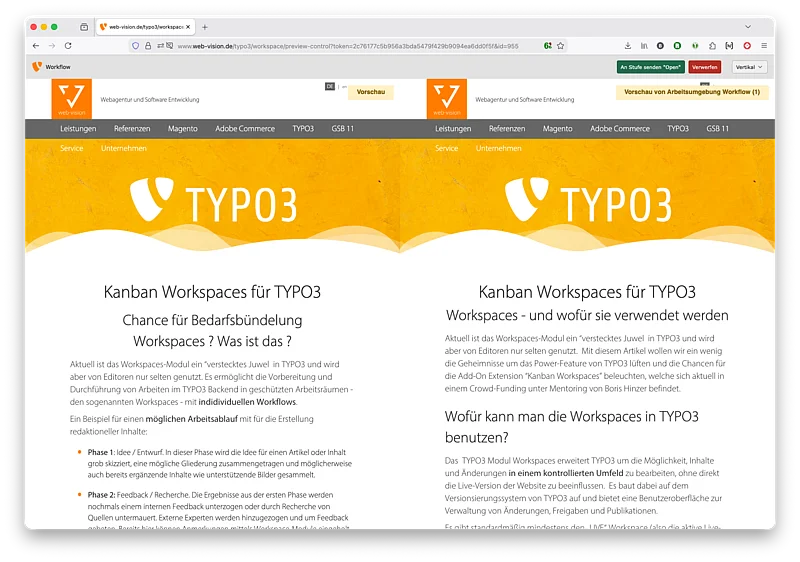
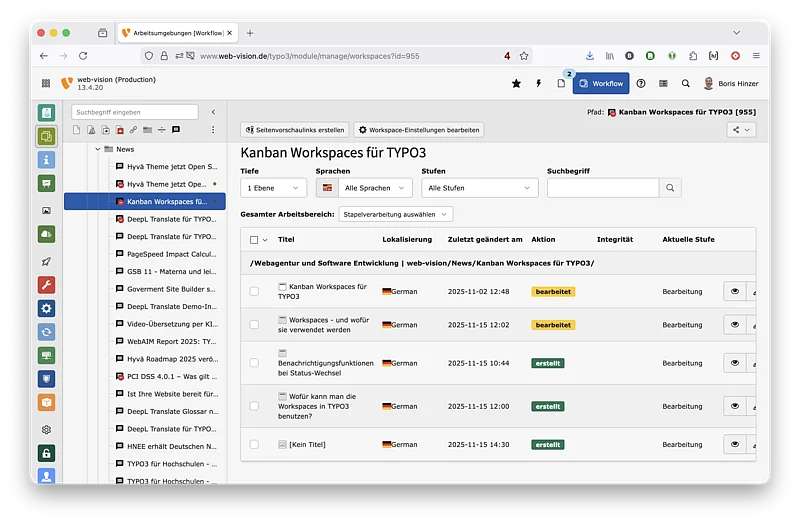
The TYPO3 Workspace module is based on a powerful version control and workflow system. Changes are not edited and published directly to the live environment but instead go through defined approval stages. This makes TYPO3 ideal for editorial teams with multiple contributors, approval processes, or quality assurance.
However, typical challenges arise in day-to-day work:
- Lists quickly become confusing as the number of changes increases.
- The editing status of a piece of content is not immediately apparent.
- Responsibilities are only indirectly traceable.
- For many editors, the workflow feels technical rather than visual.
Teams that are used to modern project management tools like Jira, Trello, YouTrack, or Azure Boards, in particular, miss a familiar way of working.
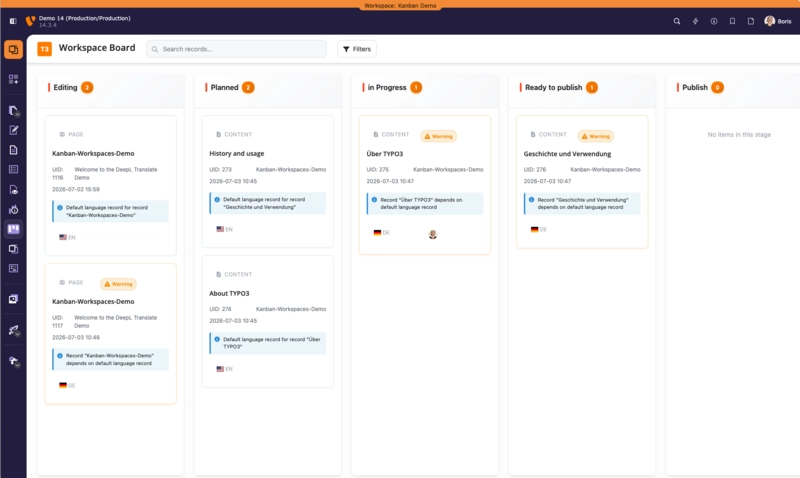
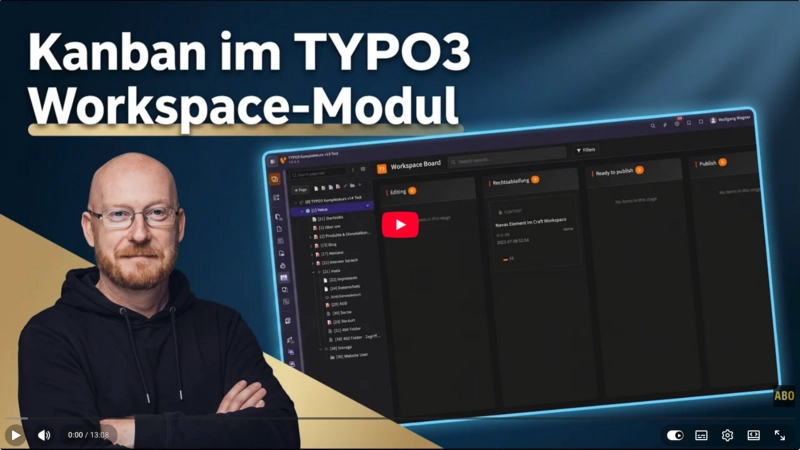
The Kanban Workspaces extension applies the familiar Kanban principle to TYPO3 workspaces.
Instead of managing changes in long tables, content appears as cards on a Kanban board. Each column represents a workspace stage, and each card represents a content element or a page. Content can be easily moved to the next editing phase via drag-and-drop. The extension continues to use only the official TYPO3 Workspace APIs—so no parallel workflow system is created.
Key Features
The current version of Kanban Workspaces already offers numerous features that make day-to-day editorial work easier:
- A clear Kanban view of all workspace content
- Drag-and-drop between individual workflow stages
- Filters by language, level, and processing status
- Search within workspace entries
- Direct support for the TYPO3 “Send to Stage” feature
- Label changes for TYPO3’s standard stages
- Disabling the automatic stage reset after saving
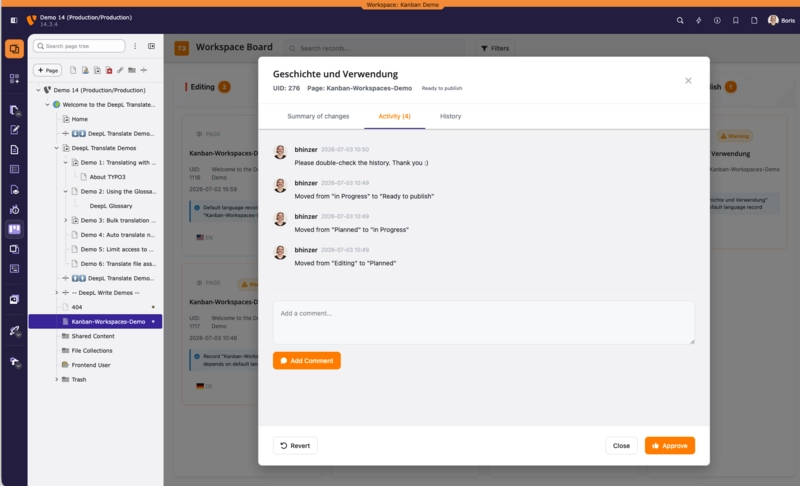
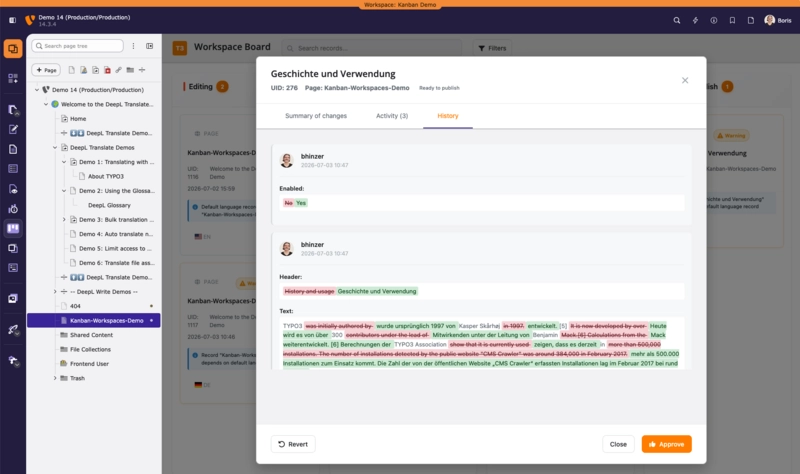
- Internal comments and history
- Assignment of content responsibilities (Assignee)
- Support for TYPO3 v13 and v14
Not a new workflow engine—but a better user interface
A key advantage of the extension is its architectural approach.
Kanban Workspaces neither replaces TYPO3 Workspaces nor extends them with its own versioning mechanisms. Instead, the extension is built entirely on top of existing TYPO3 core functions and utilizes modern technologies such as dependency injection, event listeners, and the official Workspace APIs. This ensures compatibility with the TYPO3 workflow and allows future core developments to continue to be used.
Greater Transparency for Newsrooms
Larger editorial teams, in particular, benefit from the visual presentation. At a glance, you can see:
- Which pieces of content are still in draft form?
- Which articles are awaiting approval?
- Where are bottlenecks occurring in the workflow?
- Which content is ready for publication?
Instead of working through lists, you gain an immediate understanding of the current status of the entire editorial team’s work.
Who is Kanban Workspaces best suited for?
This extension is intended specifically for:
- Companies with multi-step approval processes
- Corporate newsrooms
- Government agencies and public institutions
- Colleges and universities
- Agencies with multiple editors
- Marketing teams with regular publications
Anywhere content is created collaboratively and multiple people are involved in the publishing process, the Kanban view provides a much clearer overview.
Conclusion and Outlook
Kanban Workspaces already demonstrates how the tried-and-true TYPO3 workspaces can be used much more intuitively with a modern, visual user interface. Instead of technical lists, editorial teams get a Kanban board that shows the current processing status of all content at a glance and noticeably simplifies approval processes.
The public roadmap also shows that development goes far beyond a simple Kanban display. A key goal is to make TYPO3’s previously rigid workflow stages significantly more flexible. Currently, TYPO3 prescribes fixed standard phases such as Editing, Ready to Publish, and Publishing Execute. While individual workflow stages can be added, they must always fit between these predefined stages.
In the future, it will be possible to completely replace these standard phases with custom workflow stages or to expand them as desired. This would allow website operators to map their actual editorial process much more precisely—for example, with phases such as “Idea,” “Concept,” “Feedback,” “Internal Approval,” “SEO,” “Marketing Review,” or “Scheduled” before content is even published.
Another planned enhancement concerns the flexibility of moving content between workflow stages. Currently, content can only be moved step-by-step to the next phase. In the future, it will be possible to skip specific workflow stages and move content directly to any approved phase. This will be particularly helpful for special cases such as hotfixes, last-minute publications, or content that does not need to go through the entire approval process again after being revised.
Collaboration within the editorial team is also set to be further improved. The existing comment feature will be expanded into a modern notification system. Plans include @mentions for individual backend users as well as entire backend groups. Questions, notes, or approval requests could thus be made directly on the respective task—similar to how it works in Jira, Trello, or YouTrack. All communication would remain documented and traceable directly within the content.
Roadmap:
- #30: More flexible process control (skipping stages)
- #31: Fully configurable workflows instead of fixed TYPO3 stages
- #32: Integrated collaboration with comments and @mentions
These planned features clearly illustrate the extension’s long-term vision: Kanban Workspaces is evolving from a modern interface for TYPO3 Workspaces into a central platform for editorial and approval processes. Custom workflows, flexible process control, and integrated team communication work seamlessly together, making TYPO3 even more attractive for professional editorial teams.
Funding Opportunities
To drive the ongoing development of Kanban Workspaces in a sustainable way, we have launched an open, open-ended crowdfunding campaign.
Companies can become funding partners starting at just €985 net. As a thank-you, they’ll receive a named mention—including their logo and a backlink—in the README.md file of the code repository, as well as a permanent mention in the official extension documentation. In addition, funding partners benefit from priority access to new developments and features.
We also offer the option of feature sponsorship. Companies can specifically fund the development of individual features or extensions, thereby actively shaping the Kanban Workspaces roadmap.
Would you like to support further development or sponsor a specific feature? If so, we look forward to hearing from you at hello(at)web-vision.de.